HLB Predictor
This manual gives you a walk-through on how to use the HLB Predictor.
Introduction
The hydrophilic-lipophilic balance value (the HLB value) measures the degree of hydrophilicity or lipophilicity of a molecule. It is calculated based on identifying various hydrophil and liphophil fragments in the molecule. The HLB value is a commonly used descriptor in any workflow in which lipid based delivery can be an option (e.g. lipid-based drug delivery, cosmetics).
The HLB Predictor is a tool for predicting the HLB value. It can predict the HLB value based on the Davies, the Griffin and the Required methods.
About the Required HLB
It is important to distinguish between the HLB value of a molecule and the so called Required HLB. The HLB value is what the HLB Predictor calculates and it is a logP-like property indicating the lipophilicity and water solubility of a compound. The Required HLB, however, is an experimental value, characteristic of the compound used in (O/W) emulsions.
For detailed description of the HLB system, see the attached public presentation.
The accuracy of the HLB Predictor was tested using a set of 26 molecules with experimental HLB values. The molecules and their experimental HLB values were taken from the reference articles.
The plot below shows how the predictor performed on this test set. The calculated R2 is 0.79.
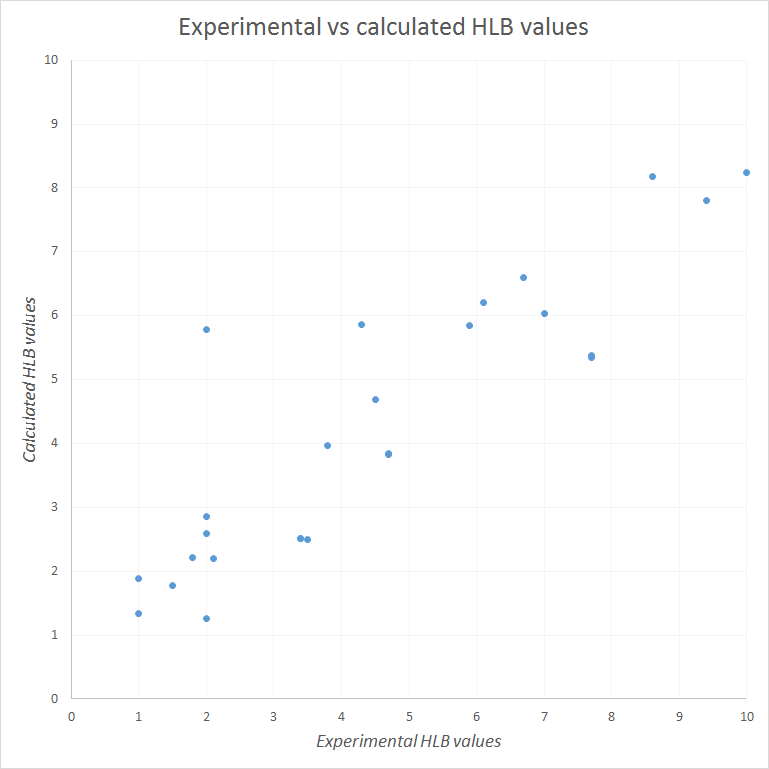
Fig. 1 The plot showing the accuracy of the HLB Predictor on the test set of 26 molecules
Usage
The HLB Predictor is integrated in various Chemaxon products.
MarvinSketch
The HLB Predictor is available as a plugin in MarvinSketch. It can be found under Calculations > Partitioning > HLB. The plugin has the following prediction methods:
- Chemaxon: this is a consensus method based on the combination of the Davis and Griffin methods with optimal weights (default)
- Davies: this is an extended version of the Davies method
- Griffin: this is an extended version of the Griffin method
- Required: this method returns the Required HLB value
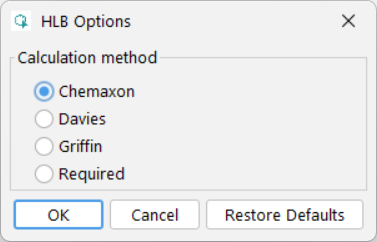
Fig. 2 The HLB Options window showing the available calculation methods
The calculation result is shown in a separate pop-up window.
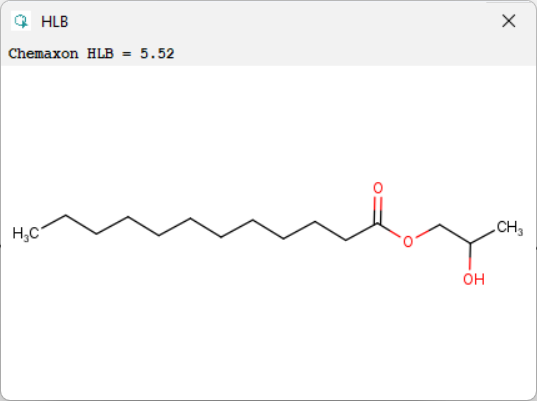
Fig. 3 The result window with the predicted HLB value and the input molecule
cxcalc
To use the HLB Predictor from the cxcalc command line tool, use the following syntax:
The following prediction options are available:
-h, --help       this help message
-p, --precision  <floating point precision as number of
                 fractional digits: 0-8 or inf> (default: 2)
-m, --method     [chemaxon|davies|griffin|required]
                 (default: chemaxon)
Here are some examples of how to use the HLB Predictor in cxcalc:
- Calculating the HLB value for an input molecule stored in SD format using the Chemaxon HLB method:
- Calculating the HLB value for an input molecule stored in SMILES using the Griffin method with 3-digit precision:
Chemical Terms
The HLB prediction functionality is also available in the Chemical Terms language via the hlb() function. The function has one parameter, the prediction method. If no parameter is specified, the calculation runs with the default method.
Here is an example of how to predict the Davies HLB value with Chemical Terms:
KNIME
The HLB Predictor is also available as a Chemaxon KNIME node. The KNIME node has the same prediction options as the HLB Plugin in MarvinSketch.
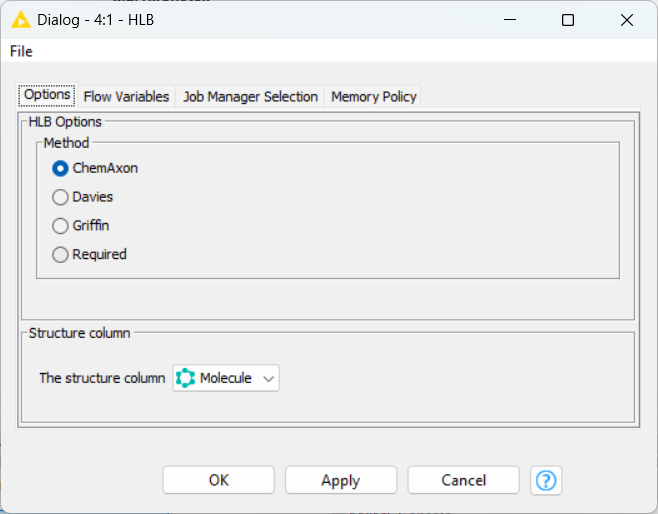
Fig. 4 The Options panel of the HLB node in KNIME
API
The HLBPlugin class with usage examples can be found here.
References
-
Davies, J.T. A quantitative kinetic theory of emulsion type, I. Physical chemistry of the emulsifying agent, Gas/Liquid and Liquid/Liquid Interface (Proceedings of the International Congress of Surface Activity), 1957 , 426–38
-
Griffin, W. C. Calculation of HLB Values of Non-Ionic Surfactants, Journal of the Society of Cosmetic Chemists, 1954, 5(4), 249-256