Handling salts in solubility prediction
This page summarizes how Chemaxon's Solubility Predictor handle salts.
Table of Contents
- Predicted vs. eperimental solubility of salts
- Best practices for handling salts
- The special case of zwitterionic salts
Predicted vs. experimental solubility of salts
When solubility is predicted for a salt compound (including salts with counter ions, solvates, hydrates and isomeric mixtures), intrinsic solubility is predicted for the neutralized form of the input structure using the Predictor's fragment-based method. Then pH-dependent solubility can be calculated from this intrinsic logS value.
Experimental solubility of a salt, however, is measured at the salt solution's pH. The Predictor does not account for this inherent solution pH, yielding difference between the experimental and the predicted solubility. Thus directly comparing experimental solubility values to predicted ones will yield misleading results.
Best practices for handling salts
To avoid misleading results you can do the followings:
- Standardize your input structure by
- stripping salts
- neutralizing
- removing solvents
- removing fragments
- Predict the solubility at the right pH value. If the experiment used a salt, use the pH of the salt solution.
If the experimental pH is unknown, comparing the predicted logS to the experimental value is invalid.
Example
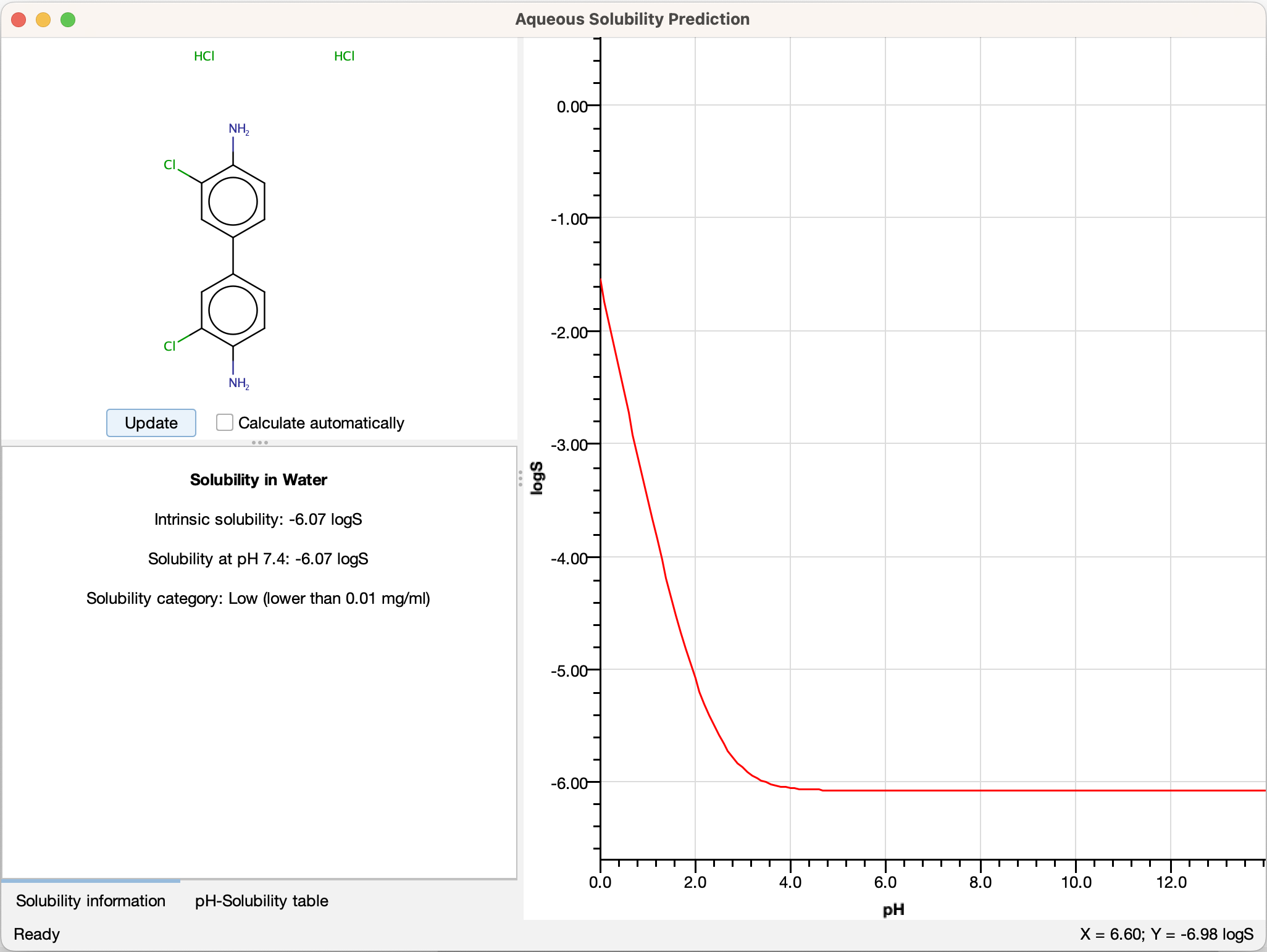
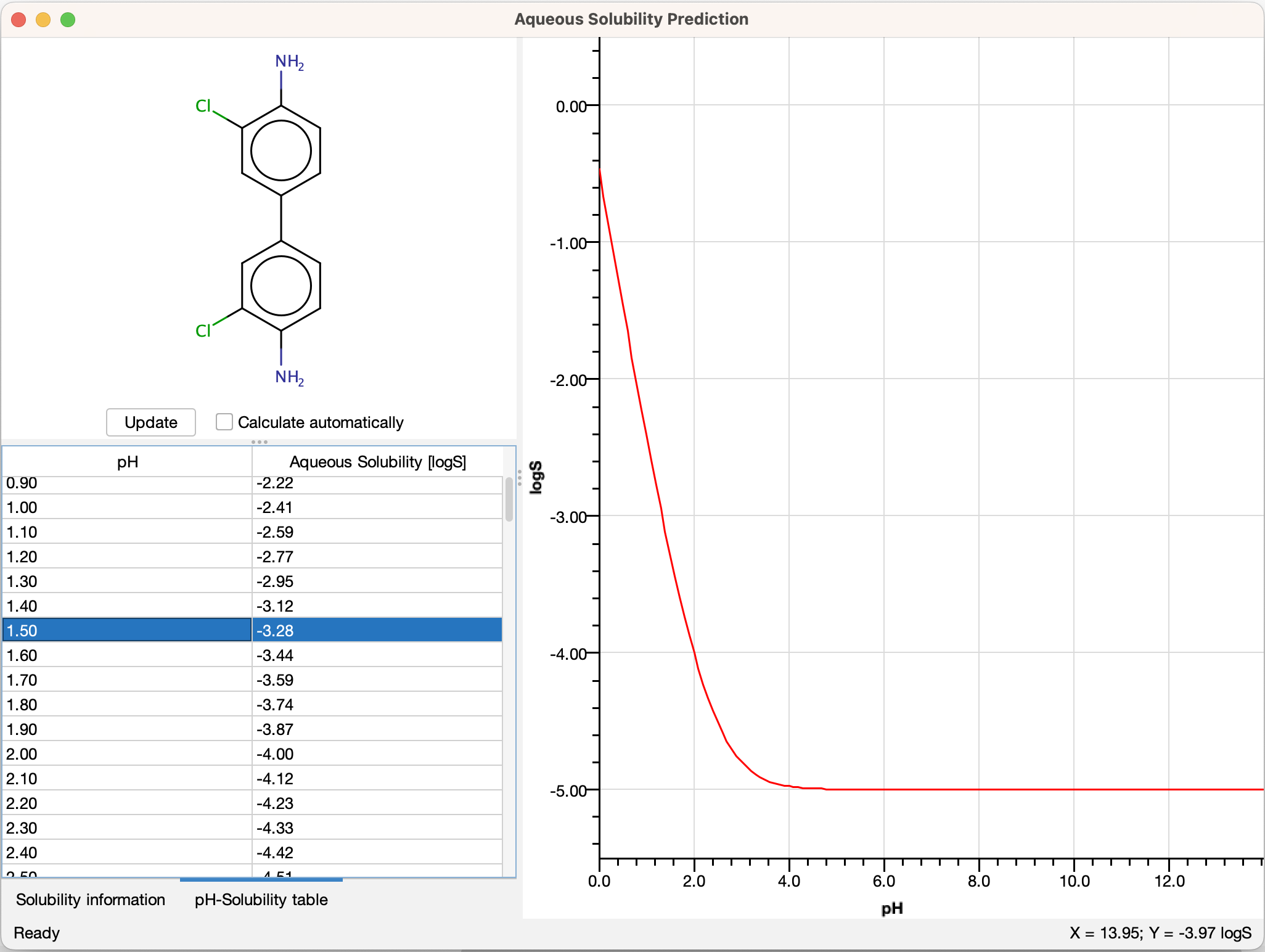
As an example we chose molecule A-1559 from the AqSolDB solubility database. Its experimental logS is reported to be -3.263.
However, there was no pH value associated to the experiment. Checking eChemPortal revealed that the salt solution pH is between 0.4 and 1.5. After standardization (removing hydrochlorides and neutralization), predicting logS at pH=7.4 yields -5.000, while predicting logS at pH=1.5 yields -3.283. This shows that comparing predicted and experimental logS values without knowing the salt solution pH gives misleading results.
The images below show that standardization and using the inherent salt solution pH are important for getting the right results.
The special case of zwitterionic salts
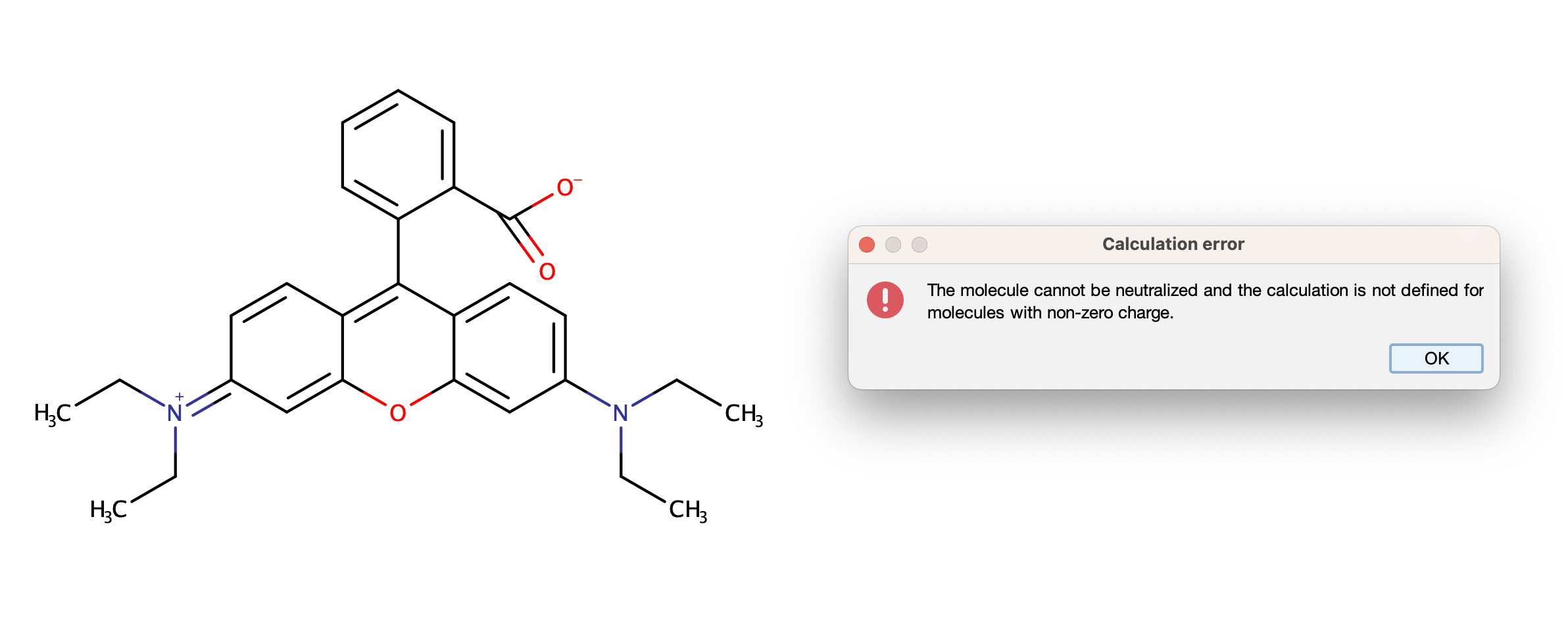
The Predictor can't handle special type of salts that are zwitterionic in a certain pH range. This issue was reported in v. 17.29.
Example
The fluorescent dye rhodamine B is a chloride salt that becomes a zwitterion in the basic pH range (pH > 7.0). However, as the quaternary N+ cannot be neutralized during standardization, we cannot calculate intrinsic solubility for it.